
Article reviewed by Jesús Andrade, an electronics engineer with an MBA from ESIC. He combines 20 years’ experience developing emergency lighting and risk-prevention devices with a strong background in business management. Andrade is currently CTO at SVE Worldwide, a company specialising in industrial risk-prevention solutions.
The duck curve and curtailment: two effects of renewable integration
The duck curve and curtailment in the power system are two concepts that help explain how renewable energy is being integrated into the traditional electricity grid. Let’s go through them step by step.
Table of contents
Renewable systems as an alternative
The duck curve: mismatch between demand and solar generation
Curtailment: when there is too much renewable energy on the grid
Solutions to the duck curve and curtailment: smart grids and energy storage
Renewable systems as an alternative
The growing —and understandable— concern about the harmful environmental effects of conventional power plants has led, for several years now, to greater renewable generation capacity and a stronger presence of these sources in the energy mix of many countries.
What does this mean for us as consumers? In principle, it should not affect us directly, but we should also understand that a greater presence of renewable energy in our power system requires some adaptation and the acceptance of certain risks.
Two interesting concepts often come up when we talk about the integration of renewable energy into electricity grids: the duck curve and curtailment. Let’s see what they mean.
The duck curve: mismatch between demand and solar generation
What is the duck curve?
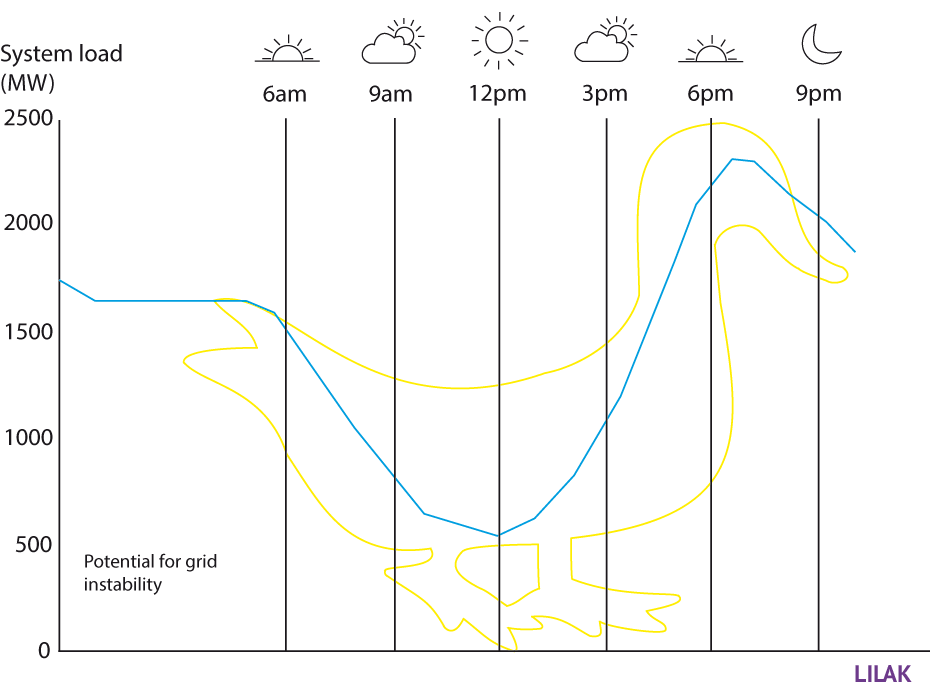
The duck curve is the name given to the chart that shows the mismatch between solar photovoltaic generation and electricity demand from consumers throughout the day. The duck curve was first popularised by the California Independent System Operator (CAISO).
Why does the duck curve happen?
The highest peaks in electricity demand usually occur late in the day, when there is no sunlight and solar power can no longer help us. On the other hand, solar generation reaches its highest output during the day —as long as there are no clouds on the horizon— when demand tends to fall considerably.
This mismatch can be seen in the following chart, which shows the demand not covered by solar photovoltaic generation. Its shape resembles a duck, which is why we call it “the duck curve”.
What does this mean?
It means that when we most need solar energy to switch on the lights or cook dinner, we cannot rely on it and need to turn to other energy sources, mainly conventional ones. This can have an environmental impact if there is not enough hydropower or other dispatchable renewable energy available.
Curtailment: when there is too much renewable energy on the grid
You may have heard this word recently. The basic rule of the power system is that supply and demand must always remain in balance: we have to consume the same amount of electricity that we produce.
Another characteristic of renewable generation systems is that they are highly variable. We cannot control the strength of the wind or the arrival of clouds. Of course, there are patterns we can identify, such as areas where the wind blows more often or places with fewer shadows where sunlight can be used more efficiently, but there is still a high degree of variability.
What is curtailment?
When we talk about the duck curve, we are referring to the hours of demand that solar generation cannot cover. Curtailment —the reduction or spilling of renewable energy— refers to exactly the opposite: an excess of renewable production that the grid is unable to manage and that can even lead to very low or near-zero electricity prices.
In these cases, the grid operator has to contact the generation plant and ask it to reduce or stop production, because there is not enough demand to use all that energy or the grid does not have enough capacity to absorb it.
In the end, that available energy, in the form of wind or sunlight, is not used because there is nowhere to consume it, store it or transport it efficiently.
Solutions to the duck curve and curtailment: smart grids and energy storage
Smart Grids
Possible solutions to reduce curtailment and flatten the duck curve include improving grid capacity, so that the system can manage the balance between supply and demand more efficiently.
In recent years, the term smart grids has become increasingly common. It refers to intelligent electricity networks that use digital technologies to predict and manage variations between supply and demand in a more efficient and sustainable way.
Flexibility through energy storage
Another solution is to make power systems more flexible. How can this be achieved?
At grid level, some countries are already implementing —or have already implemented— systems known as FESS, or Flywheel Energy Storage Systems. These are large flywheels, or inertia-based storage systems, that help stabilise the grid by maintaining the required frequency: 50 Hz in Europe and 60 Hz in the Americas. Essentially, they replicate some of the functions of traditional generation systems, while adapting better to the variability of renewable energy.
At domestic, business and industrial level, lithium iron phosphate batteries —LiFePO4— are emerging as an interesting alternative for storing energy when it is available and using it when we need it. A very clear example would be storing solar energy produced during the day so that it can be used at night, just when demand rises the most.
At LILAK, we prefer to focus on solutions rather than problems, although understanding the problems is essential. That is why we believe that giving consumers small-scale energy storage systems, in the form of backup lighting, can be a small but meaningful contribution to keeping power systems safe and sustainable. It can also become a useful resource in the event of any grid problem.
That brings us to the end of this new post. We hope you are enjoying it as much as we are. And if you experience a power outage in the next few days —although we certainly hope you do not— this information may help you understand what could be happening.