
Article reviewed by Jesús Andrade, an electronics engineer with an MBA from ESIC. He combines 20 years’ experience developing emergency lighting and risk-prevention devices with a strong background in business management. Andrade is currently CTO at SVE Worldwide, a company specialising in industrial risk-prevention solutions.
The Consumer in the Power System
How do we consume energy? This is probably the part of the chain that feels most familiar to you, although we will try to share new insights to help you better understand the impact that energy management and its transformation can have on the end consumer before it reaches our homes.
Table of contents
Electricity Supply and Demand in the Power System
The Integration of Renewables into the Power System
Solar PV self-consumption and new challenges for the power system
Electricity supply and demand in the power system
Lesson number one: in the power system, electricity supply and demand must always be in balance.
That means:
- We can’t consume more electricity than power plants are able to produce at any given moment.
- And power plants shouldn’t generate much more than the demand that exists at that same moment.
In practice, we consume exactly what is being generated in real time.
How do we consume energy?
The power system operator (or grid operator) in each country is responsible for making sure that electricity supply and demand move in sync.
How do they do that?
Roughly speaking, they rely on the fact that there are fairly stable consumption patterns:
- Over a typical day, the highest peaks usually appear in the evening, when we get home, cook dinner, turn on the TV and lights, charge our devices, etc.
- Over the week, demand is usually higher on weekdays than at weekends.
- Over the year, the period with the lowest electricity consumption is usually late summer and early autumn, when the days are still long and temperatures are mild.
Demand tends to be much higher in winter, when we need more lighting for longer hours and heating during the coldest months. In summer, demand is also high in many countries due to the widespread use of air conditioning.
All these patterns are essential for the operator to plan ahead and keep supply and demand of electricity in balance.
The Energy Mix
The system operator, in charge of the electricity supply, uses these demand patterns to decide how much generation is needed at each moment. As we’ve just said, generation and demand must always match.
What is the energy mix?
Electricity supply is made up of different generation technologies. The combination of all these sources is called the energy mix – the mix of generation technologies used in a country or region to meet electricity demand.
You can think of the energy mix as a recipe where each technology is a different ingredient:
- In some countries, nuclear power is a major ingredient.
- In others, renewable energy sources dominate, as long as there is enough installed capacity and suitable conditions.
For example, solar PV tends to play a bigger role in summer and during the daytime, when days are longer and skies are clearer.
Countries are also interconnected with their neighbours, so it’s possible to import and export electricity. That means your national energy mix doesn’t only depend on domestic power plants, but also on cross-border flows.
To decide which types of power plants are needed to cover demand, the operator looks at:
- Peak hours (when demand increases significantly).
- Off-peak hours or valley periods (when demand is more stable and low).
Conventional generation systems (including hydropower) – based on the rotational inertia of a generator shaft or very stable technologies like nuclear power – are well suited to cover demand in a reliable way.
It’s also worth mentioning that some technologies, like nuclear, are more flexible than others in terms of location: you can build nuclear plants close to major demand centres or areas of economic interest, while hydropower plants are limited by where suitable water resources exist.
Integrating renewable energy into the power system
However, this picture has changed a lot in recent decades.
As we’ve become more aware of the negative impacts of conventional fossil-based energy sources, energy policy and investment have shifted to favour renewable energy systems.
Burning coal continuously in thermal power plants, for example, releases large amounts of CO₂, which increases global warming and has severe consequences for life on the planet.
How are renewable energy sources integrated into the grid?
As a response to this, many countries have started to phase out highly polluting generation sources and replace them with renewable energy sources, which are much less harmful to the environment.
Among the renewable energy sources we saw in the previous post, two stand out today:
- Wind power
- Solar photovoltaic (solar PV)
These two already provide a large share of the energy mix in many countries.
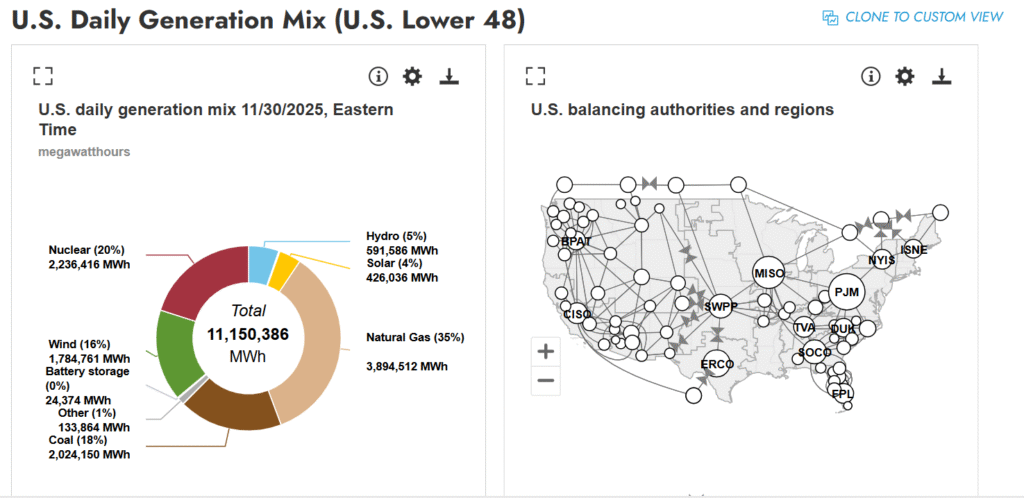
In the United States, the U.S. Energy Information Administration (EIA) provides the following data on the daily electricity generation mix.
If we look at the UK’s National Energy System Operator (NESO), we can find similar information about its electricity mix.
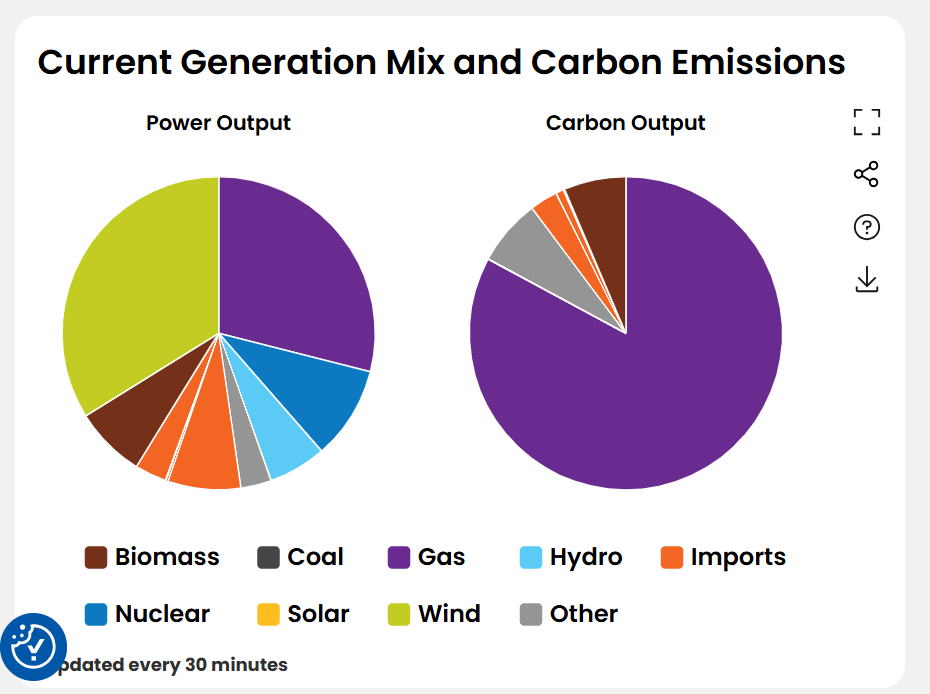
This growing share of wind and solar PV in the electricity generation mix is a huge challenge for system operators.
Why?
Because, as you’ve probably guessed, the main issue with these sources is their high variability.
- With conventional power plants, we can control their output in a relatively predictable, stable way – at the end of the day, the rotation of a generator shaft is highly controllable.
- With wind and solar PV, generation is much harder to predict: it depends on weather conditions and can change quickly, both in total output and in how much each source is contributing to the system.
Solar PV self-consumption and new challenges for the power system
Another important change is that many households and businesses have started to install their own rooftop solar panels.
The relatively low cost and ease of installation of solar PV means that many users are choosing solar PV self-consumption: producing part of their own electricity on their roofs and consuming it directly at home.
Their goals are usually:
- To be more independent from the grid and potential supply problems.
- To save money and get better economic returns than relying exclusively on grid electricity.
But this growing solar PV self-consumption also has consequences for the power system:
- It changes the shape of demand seen by the grid.
- It adds more distributed generation connected at low voltage.
- It increases the need for flexibility in both consumption and generation.
All of this is driving the sector to talk more and more about:
- System flexibility, and
- Solutions such as energy storage – batteries and other technologies that can store electricity when there is surplus generation (for example, on a sunny or windy day) and release it when demand is high or renewable output is low.
We’ll go deeper into energy storage and these new flexibility solutions in future posts.
A final thought
We’ve covered a lot of ground, so let’s stop here for today.
Hopefully this series has helped you see the power system in a different way.
And maybe next time you switch on a light at home, you’ll wonder:
- Is this electricity coming from the wind?
- From the sun?
- From a nuclear power plant?
If we’ve sparked that curiosity, we can already say this journey was worth it.